Table of Contents Show
If you are serious about landing remote AI jobs in 2026, the platform you use matters as much as the skills you bring. The remote job market has shifted fast — remote job postings grew 20% in Q1 2026 alone, yet fully remote roles still draw 2.6 times more applications than in-office positions. That means competition is real, and using the right tools can be the difference between getting noticed and getting ignored.
This guide covers the top tools and platforms for remote AI jobs in 2026 — what each one is, how to use it, the pros and cons, and exactly what it costs. No filler. Just what you need to make a smart decision.
What to Look for in a Remote AI Jobs Platform in 2026
Before diving into the list, here is what separates a platform worth your time from one that wastes it:
Verified listings — Scam job posts are everywhere. Platforms that vet their listings save you time and protect you from fraud.
AI-specific filters — Not every remote job board focuses on tech or AI. You want platforms where you can filter specifically for machine learning, data science, prompt engineering, or AI consulting roles.
Application tools — The best platforms do not just show you jobs. They help you apply smarter — with resume reviews, AI mock interviews, skills tests, and automated alerts.
Fee transparency — Some platforms charge job seekers. Some charge employers. Some take a cut of your earnings. Know what you are signing up for before you commit.
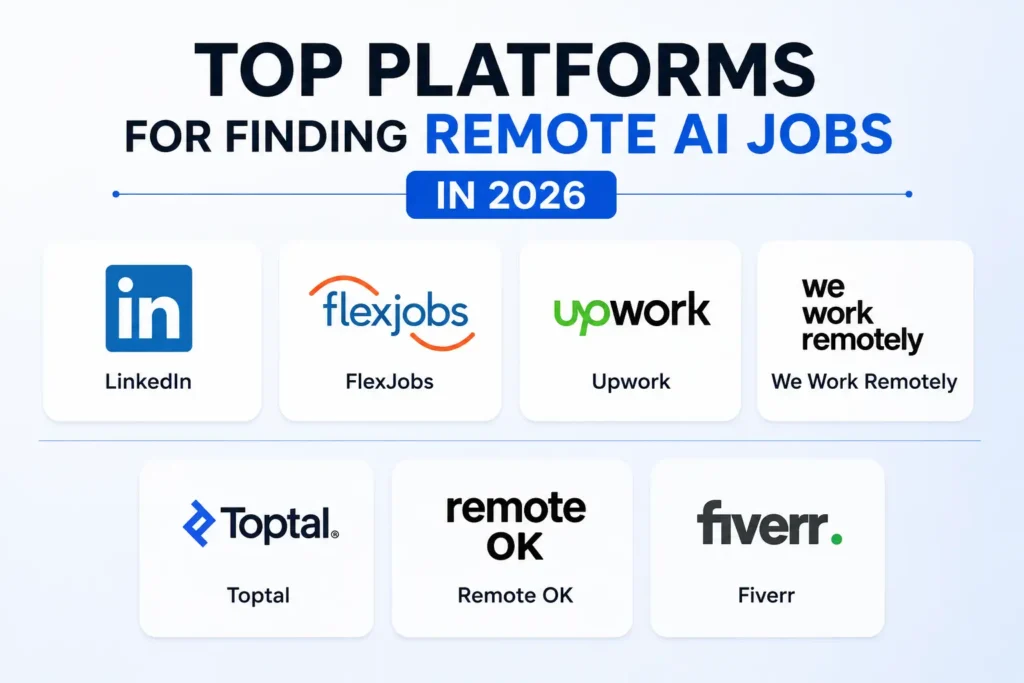
Top Platforms for Finding Remote AI Jobs in 2026
1. LinkedIn
What it is: The world’s largest professional network with over 1.1 billion members. LinkedIn is not just a job board — it is a full career ecosystem where jobs are posted, professionals network, and recruiters actively headhunt.
How to use it for remote AI jobs: Set your profile to “Open to Work” and specify remote roles. Use the job search filter to select “Remote” and search for terms like “AI engineer,” “machine learning,” “prompt engineer,” or “AI consultant.” Enable job alerts so you are notified the moment new listings go live. The key advantage on LinkedIn is the hidden job market — up to 70–85% of jobs are filled through networks before they are even publicly posted.
Pros:
- Free to use for job seekers
- Massive volume of AI and tech job listings
- Direct access to recruiters and hiring managers
- Strong for networking and building visibility in the AI space
Cons:
- High competition on popular listings
- Best features require a paid LinkedIn Premium subscription
- Requires an active, well-optimized profile to stand out
Pricing: Free. LinkedIn Premium starts at approximately $40/month and includes InMail credits, profile viewers, and AI-assisted application tools.
Best for: Anyone serious about a career in AI who wants to combine job searching with networking and personal branding.
2. FlexJobs
What it is: A curated remote job board that manually vets every single listing before it goes live. FlexJobs has served over 10 million job seekers and is widely considered the most reliable platform for scam-free remote work.
How to use it for remote AI jobs: Search specifically for AI, machine learning, data science, or tech roles using FlexJobs’ advanced filters. Use their entry-level filters if you are just starting out — about 7% of their listings are entry-level. Take advantage of their 200+ skills tests, AI mock interview tools, and resume review services to strengthen your application before you send it.
Pros:
- 100% vetted listings — no scam jobs
- Includes career tools: skills tests, resume reviews, and AI mock interviews
- Remote-only and flexible work focus
- Trusted by major employers including Fortune 500 companies
Cons:
- Requires a paid subscription to access full listings
- Only 7% of listings are entry-level — skews toward experienced candidates
- Smaller job volume compared to free boards like Indeed or LinkedIn
Pricing: Around $14.95/month or approximately $4/month on an annual plan. A weekly trial is available at $6.95.
Best for: Job seekers who want verified, high-quality remote AI listings and are willing to pay a small fee for peace of mind and built-in career tools.
3. Upwork
What it is: The world’s largest freelance marketplace with over 18 million freelancers and 796,000 active clients. Upwork connects independent professionals to project-based work across technology, design, writing, marketing, and more — including a fast-growing category of AI-related gigs.
How to use it for remote AI jobs: Create a detailed profile highlighting your AI skills — prompt engineering, data labeling, AI content creation, model testing, or chatbot development. Search for AI-specific projects and set up instant job alerts. Upwork’s AI-driven recommendation system matches your profile to relevant listings with 89% accuracy, making it easier to find the right opportunities faster.
Pros:
- Available in 180+ countries — accessible globally
- AI-powered job matching with 97% payment success rate
- Flexible — choose your own hours and projects
- Wide range of AI gigs from beginner to expert level
Cons:
- Takes 20% of your first $500 with each client, dropping to 10% then 5% as you earn more
- Competitive — popular projects attract many proposals
- Building reputation from zero takes time and patience
Pricing: Free to join. Upwork takes 20% on your first $500 earned with a client, 10% from $500.01 to $10,000, and 5% beyond that.
Best for: Freelancers who want flexible, project-based AI work and are comfortable building a profile and reputation over time.
4. We Work Remotely
What it is: One of the largest free remote job communities, with a strong focus on tech, design, and marketing roles. It is particularly popular with startups and tech-forward companies hiring for AI and software roles.
How to use it for remote AI jobs: Browse the Programming, DevOps, or Management & Finance categories where most AI-related roles appear. No account is required to browse — listings are straightforward and easy to filter. Set up email alerts for specific keywords like “AI,” “machine learning,” or “data science.”
Pros:
- Completely free for job seekers
- Strong tech and startup focus
- Clean, simple interface with no distractions
- High-quality listings from established remote-first companies
Cons:
- No vetting process — listings are not manually verified
- Fewer tools compared to paid platforms like FlexJobs
- Smaller job volume than LinkedIn or Indeed
Pricing: Free.
Best for: Tech professionals looking for full-time remote AI roles at startups and remote-first companies without paying a subscription fee.
5. Toptal
What it is: An exclusive freelance network that accepts only the top 3% of applicants after a rigorous multi-stage screening process. Toptal serves Fortune 500 clients and premium businesses looking for elite AI, software, and design talent.
How to use it for remote AI jobs: Apply through Toptal’s screening process — which includes a language and personality assessment, technical skills evaluation, live project simulation, and a paid test engagement. It is demanding, but once accepted, you gain access to high-paying clients actively looking for senior AI talent.
Pros:
- Access to premium, high-paying clients
- Hourly rates typically range from $60–$150+
- Strong reputation that opens doors beyond the platform
- No cold pitching — Toptal matches you directly to clients
Cons:
- Extremely competitive — only 3% of applicants are accepted
- Not suitable for beginners or those without a proven AI track record
- Less project variety compared to Upwork
Pricing: Free for freelancers. Toptal charges clients a premium fee, not the talent.
Best for: Senior AI professionals with a strong portfolio who want access to high-value projects without the grind of a traditional job search.
6. Remote OK
What it is: A remote job board with over 129,000 active listings, updated every 10–20 minutes. Remote OK has a heavy focus on tech roles and is one of the fastest-moving boards for AI, software, and data science jobs.
How to use it for remote AI jobs: Search by tag — “AI,” “machine learning,” “deep learning,” or “data science” — and filter by salary range and location restrictions. Remote OK lists salary ranges transparently on most listings, which is a major advantage when comparing opportunities.
Pros:
- Free for job seekers
- Real-time listings updated very frequently
- Transparent salary data on most listings
- Strong tech and AI job focus
Cons:
- No listing verification — quality can vary
- No built-in application tools or career resources
- Minimal interface — less guidance for first-time remote job seekers
Pricing: Free.
Best for: Experienced tech and AI professionals who know what they are looking for and want a fast, high-volume board with transparent salaries.
7. Fiverr
What it is: A gig-based freelance marketplace where sellers create service listings (“gigs”) that buyers can purchase directly. Fiverr has a growing category of AI-related services including prompt engineering, AI image generation, AI copywriting, and chatbot setup.
How to use it for remote AI jobs: Create a seller profile and list your AI skills as specific gigs — for example, “I will write custom ChatGPT prompts for your business” or “I will build an AI chatbot for your website.” Price your gigs competitively at first to build reviews, then increase your rates as your reputation grows.
Pros:
- Low barrier to entry — anyone can create a gig and start earning
- No need to pitch clients — buyers come to you
- Great for packaging AI skills into sellable services
- Global reach with buyers from every industry
Cons:
- Fiverr takes a flat 20% of every transaction
- Competition at lower price points is intense
- Income can be inconsistent, especially in the early months
Pricing: Free to join. Fiverr takes 20% of each sale.
Best for: Beginners who want to start earning from AI skills quickly without a formal job application process.
Top Tools to Help You Land Remote AI Jobs in 2026 Faster
Beyond job boards, these tools help you apply smarter, prepare better, and stand out in a crowded field.
JobCopilot
An AI-powered job application tool that automatically applies to remote jobs on your behalf based on your profile and preferences. It saves hours of manual searching and applying — especially useful when you are targeting high-volume boards like Indeed or LinkedIn.
Best for: Job seekers who want to apply consistently without spending hours every day doing it manually.
Resume Worded / Jobscan
AI resume optimization tools that analyze your resume against specific job descriptions and tell you exactly what to change to pass ATS (applicant tracking systems). Most AI job applications are screened by software before a human ever sees them — these tools help you get past that filter.
Best for: Anyone whose applications are not getting responses despite being qualified.
Big Interview
A dedicated AI mock interview platform that helps you practice answers to common interview questions, receive instant feedback on your delivery, and build confidence before the real thing. It can also be accessed through FlexJobs as part of their career tools suite.
Best for: Candidates who want to sharpen their interview performance for competitive remote AI roles.
LinkedIn Premium
Adds features like seeing who viewed your profile, sending InMail directly to recruiters, and accessing AI-driven insights on how your application compares to other candidates. In a competitive market for remote AI jobs, these insights help you prioritize where to focus your energy.
Best for: Active job seekers using LinkedIn as their primary job search channel.
Which Platform Should You Start With?
Here is a simple decision guide based on where you are right now:
You are a beginner with no AI job experience yet → Start with Fiverr to build your portfolio and Upwork to land your first freelance clients. Use FlexJobs’ free skills tests to strengthen your profile before applying.
You have some experience and want a full-time remote role → Focus on LinkedIn and We Work Remotely. Set up daily alerts and apply consistently. Use JobCopilot to automate the volume.
You are an experienced AI professional targeting high-paying roles → Apply to Toptal, monitor Remote OK for salary-transparent listings, and invest in LinkedIn Premium for recruiter visibility.
You want to freelance on your own terms → Upwork for long-term client relationships, Fiverr for quick gigs, and Toptal once you have the portfolio to qualify.
Before You Start Applying
The tools and platforms are not the hard part. The hard part is consistency — showing up every day, applying, refining your profile, and building skills while you search.
Remote AI jobs in 2026 are real, they pay well, and they are genuinely accessible to people who prepare properly. The platforms above give you every advantage you need. The rest is on you.
Which of these platforms are you going to try first? Drop a comment below — if you have a question about any of them, I will give you a straight answer based on what actually works.
Disclosure:
This article may contain affiliate links. If you click on a link and make a purchase, I may earn a small commission at no extra cost to you. I only recommend tools and resources I genuinely believe are useful.